
Intro
In the injection mold opening process, the choice of runner system directly determines the production cost, production efficiency, product quality, and even the difficulty of later maintenance.
So, when making injection molds, should you choose a hot runner or a cold runner?
The differences between hot runner and cold runner
1, Different structures
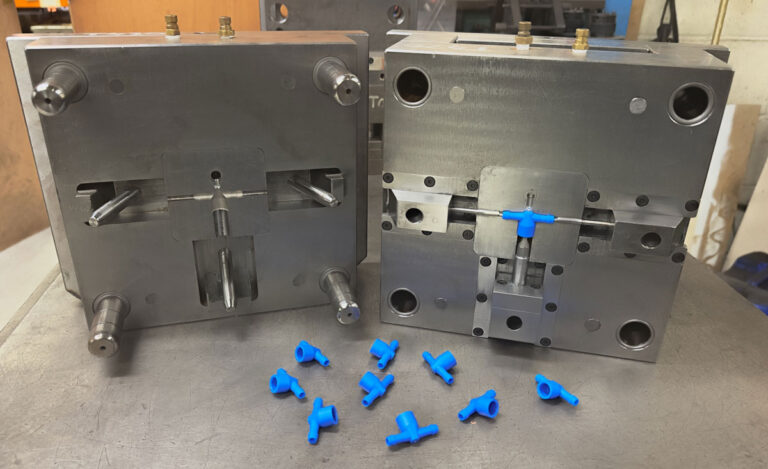
The Cold runner is the most traditional runner design and belongs to the “heat-free design”. Its structure mainly consists of main runner, branch runner, gate and cold slug well. The material is the same as the mold cavity, mostly mold steel such as P20 and 718H, and it relies on the mold’s own cooling system for cooling.
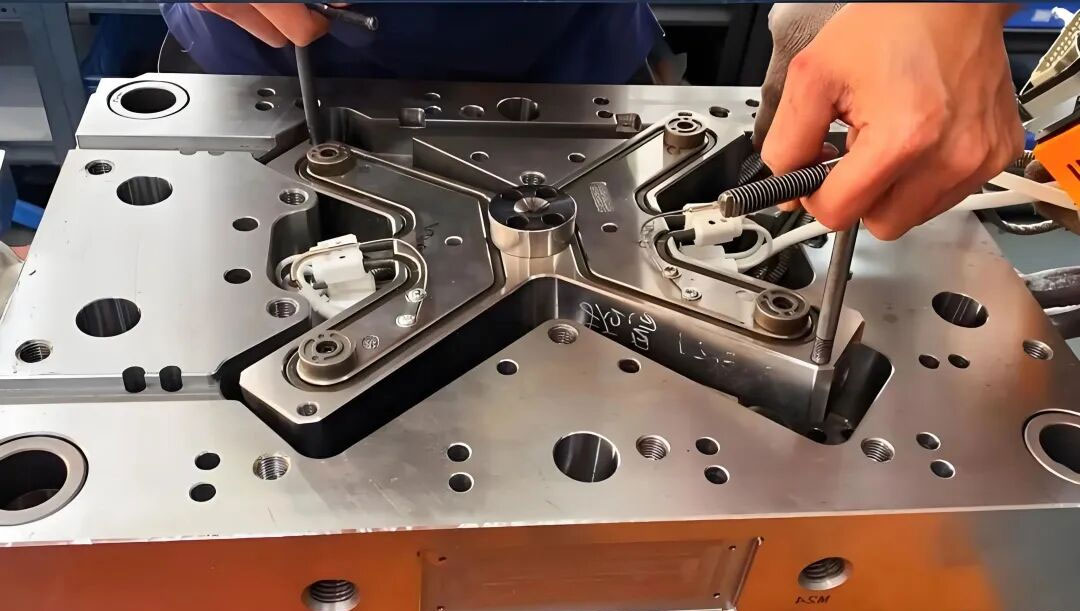
The hot runner is a “precision model with a heating system,” and its structure consists of a hot runner plate, hot nozzles, and a temperature control system.
2, They work on different principles
When the cold runner is working, the molten plastic enters the cold runner from the injection molding machine nozzle and gradually solidifies as the mold cools down.
After the mold is opened, the solidified runner material will be removed together with the finished product. It is necessary to separate the solidified material from the finished product manually or with equipment. The solidified material can be recycled and reused, but some loss will occur.
The working principle of hot runner is to keep the molten plastic in the runner in a molten state through heating coils, heating rods and other components. After the mold is opened, only the finished product is ejected, and no solidified material is generated in the runner, so no subsequent separation process is required.
Hot runners can also be divided into two types: open type and needle valve type.
Open structures are simple and low-cost, but they are prone to “stringing” or “drooling,” and low-viscosity materials should be used with caution.
Needle valve type injection molding controls the gate opening and closing via hydraulic/pneumatic cylinders, which can prevent drooling. It is suitable for low viscosity materials (such as PE, PP) and high precision products, and is currently the mainstream choice for high-end injection molding.
3, Performance differences
First, in terms of production efficiency, cold runner molds are not as efficient as hot runner molds
After the mold for cold runners is opened, the solidified material needs to be separated manually or by equipment, and then crushed and recycled. The process is complicated and cannot achieve fully automated production.
In addition, the melt will gradually cool down in the cold runner, and the temperature drop will increase the filling pressure, especially in long runner and multi-cavity scenarios, which will prolong the molding cycle.
Hot runner molds have no runner solidified material, and the finished product can be directly taken out after the mold is opened without the need for subsequent separation and recycling processes, which can realize fully automated production and greatly shorten the molding cycle.
Meanwhile, the melt temperature is stable and the filling pressure loss is small, which can reduce the waiting time during the molding process.
Secondly, in terms of product quality, hot runner products have more stable quality
In cold runner molds, the melt cools unevenly in the runner, which can easily lead to defects such as cold spots, weld lines, and shrinkage cavities. Gate marks are also obvious, resulting in poor product precision and appearance consistency.
In addition, cold runners require extra cleaning when changing colors, which can easily lead to color mixing and affect product quality.
The hot runner temperature control system can precisely control the melt temperature, ensuring that the melt enters the cavity in a uniform and stable state, reducing defects such as weld lines and cold spots, resulting in smaller gate marks, smoother product surfaces, and higher precision.
At the same time, hot runners can achieve uniform feeding in multiple cavities, ensuring consistent quality of products with multiple cavities, which is difficult to achieve with cold runners.
Thirdly, in terms of maintenance difficulty, cold runners are simpler to maintain
Cold runners do not have complex heating or temperature control components. Routine maintenance only requires cleaning the runner, checking the cold slug well and the pull rod. When a fault occurs, the repair cost is low and the cycle is short. Ordinary operators can complete the maintenance without the need for professional technicians.
Hot runners involve precision components such as heating coils, heating rods, and temperature controllers. These components are easily damaged and require regular inspection and replacement. Once melt leakage or heating element failure occurs, it will not only affect product quality but also interrupt production. The repair costs are high and the cycle is long, requiring professional technicians to operate and maintain them.
Finally, in terms of material compatibility, cold runners are more versatile and flexible
Cold runners are highly adaptable to almost all plastics, especially heat-sensitive materials (such as PVC), preventing the materials from decomposing due to prolonged heating. They are also compatible with highly filled materials (such as glass fiber reinforced plastics) without causing runner wear, offering exceptional flexibility.
The material compatibility of hot runners is somewhat limited. They are not suitable for heat-sensitive materials (which are prone to decomposition when heated for a long time) or highly filled materials (such as glass fiber reinforced plastics, which can easily wear down the nozzles).
However, for high-viscosity materials (such as PC), transparent materials (such as PMMA), and low-viscosity materials (such as PE and PP), hot runners are more adaptable and can effectively solve problems such as poor material flow and product defects.
4, Cost differences
The advantage of cold runner systems is that the initial investment cost is lower. Because the mold structure is simple and the processing difficulty is low, there is no need to equip it with an additional heating and temperature control system. The mold cost is 30% to 60% lower than that of hot runner systems. The initial investment is small, making it suitable for scenarios with limited budgets.
However, it has long-term loss costs —the proportion of solidified material in the flow channel is high, requiring manpower to separate, crush and recycle it, which not only wastes materials but also increases labor costs. During long-term mass production, the loss will gradually accumulate.
The drawback of hot runner systems is the higher initial investment. Because the mold structure is complex, it requires precise heating and temperature control components, making the mold cost significantly higher than that of cold runner systems, resulting in a larger initial investment.
However, it can save on long-term losses —the channelless condensate has a material utilization rate of over 95%, and there is no need for manual separation of condensate, which can significantly reduce material waste and labor costs. In long-term mass production, the cost savings can offset the initial investment and even generate profits.
How should I choose between the two?
Understanding the differences between the two makes selection much easier—there is no single best flow channel, only the one that best suits your needs. Below, we provide clear selection recommendations based on core factors such as production volume, product requirements, material properties, and budget.
1, Prioritize scenarios with cold runners
Small-batch production (annual output < 50,000 units): low initial investment, no need to bear the high cost of hot runners, and even if there is material loss, the overall cost is more controllable.
Frequent switching between multiple product types and small batches: The cold runner is easy to maintain, and color switching and mold adjustment are more convenient, without the need to spend a lot of time debugging the temperature control system.
Low product requirements: No high requirements for appearance or precision, such as daily necessities, low-precision industrial parts, turnover boxes, etc.
Using heat-sensitive materials (such as PVC) or highly filled materials (such as glass fiber reinforced plastic): cold runners can avoid problems such as material decomposition and runner wear.
Limited budget: Initial funding is insufficient, the focus is on low-cost mold development, and there are no plans for large-scale production in the short term.
2, Scenarios where hot runners are preferred
Mass production (annual output > 500,000 units): In the long run, the advantages of no material waste and high automation can offset the high initial investment and significantly reduce overall costs.
High product requirements: Strict requirements are placed on appearance (no gate marks, no weld marks) and precision, such as mobile phone casings, electronic connectors, transparent parts, and automotive interior parts.
Thin-walled, long-process products: stable melt temperature and low filling pressure loss, which can avoid problems such as material shortage and deformation of thin-walled parts.
Multi-cavity molds: Hot runners enable uniform feeding into multiple cavities, ensuring consistent quality for each product and improving production efficiency.
Pursuing automated production: No need for manual separation of granules, it can be connected to automated production lines, reducing labor costs and improving production stability.
Expert Views from Gaofeng
In short, the key to choosing between hot runner and cold runner for injection molds is to balance cost and demand.
At the same time, it is necessary to make a comprehensive judgment based on factors such as product structure (size, wall thickness), material properties, and production equipment. If necessary, flow analysis can be used to simulate flow channel pressure loss and filling uniformity to ensure accurate selection.